
Yellow Tail Acei
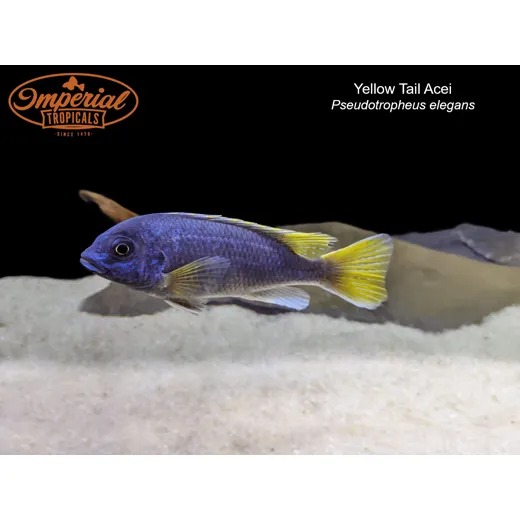
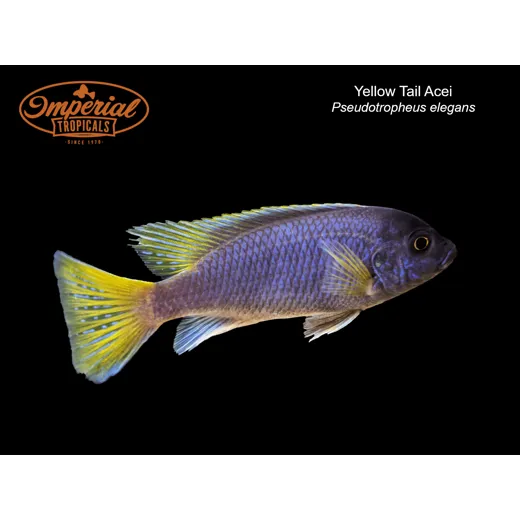
Remarks: The Yellow Tail Acei is a fairly large mbuna with both males and females sporting a dark blue/purple body and yellow fins. Another variant of this species also exists that has white fins so it is known as the white tail acei.
Scientific Name: Pseudotropheus elegans
Common Name: Yellow Tail Acei
Specifications
| Parameter | Value |
|---|---|
| Max Size | 6″ |
| pH | 7.5-8.4 |
| Hardness | Hard |
| Temperature | 74-82° |
| Aggressiveness | Aggressive |
| Region of Origin | Lake Malawi, Africa |
| Captive Bred or Wild | Captive Bred |
| Diet | Not specified |
| Compatibility | Mbuna – Melanochromis, Pseudotropheus |
FAQ
What is the typical size of a Yellow Tail Acei?
The maximum size of a Yellow Tail Acei is 6 inches.
What water conditions does the Yellow Tail Acei require?
It thrives in water with a pH of 7.5 to 8.4 and hard water, with a temperature range of 74 to 82°F.
Is the Yellow Tail Acei aggressive?
Yes, the Yellow Tail Acei is known to be aggressive, especially in confined spaces or when competing for territory.


Dan Ince –
The Yellow Tail Acei is a striking fish with vibrant blue and yellow coloring. It’s active and adds a lot of visual interest to the tank. I’ve kept it with other mbuna, but I need to be careful with tank mates due to its aggressive nature. Feeding is straightforward with quality flakes and occasional live foods.
Adrian Wallace –
Great coloration and active behavior. The fish is slightly aggressive, so I made sure to provide plenty of hiding spots. It’s a captive-bred specimen, which is a plus for ethical sourcing. I’ve seen some white-finned variants in the wild, but this one has the classic yellow tail.
Piers Wilson –
The fish looks beautiful and is a good addition to a Malawi mbuna tank. However, it can be territorial, especially during feeding times. I recommend keeping it with compatible species like Melanochromis. It’s not the easiest to maintain due to the water parameter requirements.