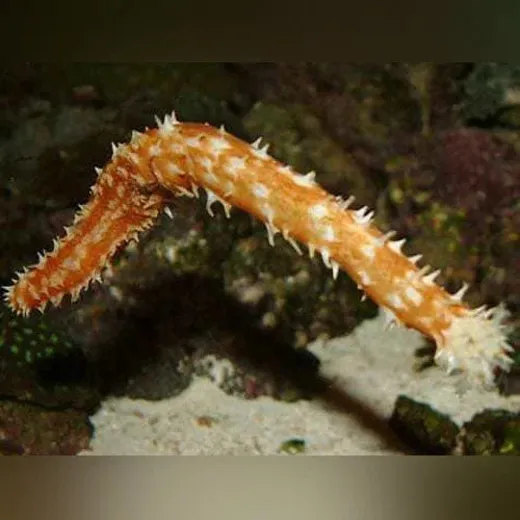
Tiger Tail Cucumber: The Sand-Sifting Marine Housekeeper
The Tiger Tail Cucumber (Stichopus sp.) is one of the most popular and visually interesting members of a marine clean-up crew. While the genus Stichopus sp. is often used, this name commonly refers to species like Holothuria hilla or Holothuria impatiens in the aquarium trade. This invertebrate is valued for its continuous sand-sifting behavior, playing a vital role in maintaining a clean, healthy, and aerated substrate.
Native to the Indo-Pacific, the Tiger Tail Cucumber has an elongated, cylindrical body that is typically mottled brown and tan with subtle stripes and small, spiny papillae, giving it its namesake appearance. It can grow up to 12 inches (30 cm) in length.
| Specification | Detail |
|---|---|
| Species | Stichopus sp. (commonly Holothuria hilla or Holothuria impatiens) |
| Origin | Indo-Pacific region |
| Body Shape | Elongated, cylindrical |
| Color | Mottled brown and tan with subtle stripes |
| Size | Up to 12 inches (30 cm) |
| Behavior | Continuous sand-sifting |
FAQ
What is the typical size of a Tiger Tail Cucumber?
The Tiger Tail Cucumber can grow up to 12 inches (30 cm) in length.
Where is the Tiger Tail Cucumber originally from?
It is native to the Indo-Pacific region.
How does the Tiger Tail Cucumber benefit a marine aquarium?
It continuously sifts through the substrate, helping to keep the tank clean, reduce sediment buildup, and improve substrate aeration.


Maria Hill –
Added the Tiger Tail Cucumber to my reef tank and it’s been actively sifting through the sand every day. The tank feels cleaner and the substrate is less messy. It’s a quiet, hardworking addition that doesn’t interfere with other inhabitants.
Caroline Mathis –
It’s a unique-looking creature with a distinct pattern. After a few weeks, I noticed the sand around the tank base was much cleaner. It doesn’t require much attention and blends well with the environment.
Joseph Bell –
The cucumber has been very active since arrival. I can see it moving through the sand regularly, which helps maintain a healthy substrate. It’s a low-maintenance, effective clean-up organism.