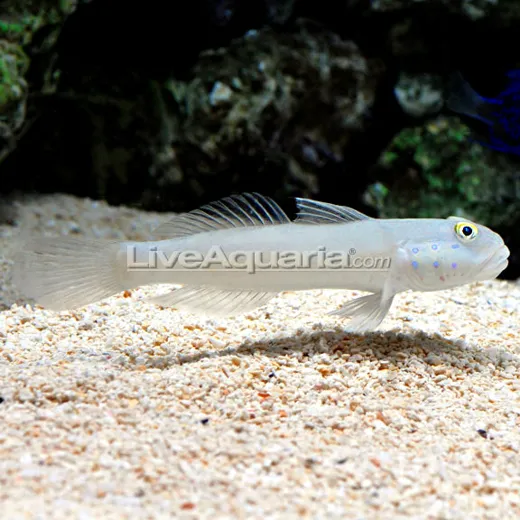
Sleeper Blue Dot Goby
The Sleeper Blue Dot Goby, also known as the Ladder Glider, Ladder Goby, or Sixspot Sleeper Goby, has a white body with bright blue spots under the eyes and mouth.
To successfully care for this fish, it should be housed in a 30 gallon or larger aquarium with live sand as the substrate, and an attached populated refugium. It rarely becomes aggressive towards other fish, but is territorial and will fight with its own kind unless they are a mated pair.
The Sleeper Blue Dot Goby feeds by sifting through the bottom sand, consuming substrate and the small organisms living within it. The diet should include a variety of live and frozen brine shrimp, mysis shrimp, live black worms, and prepared carnivore foods. It should be fed regularly, with small portions provided daily.
| Specifications |
|---|
| Common Name: Sleeper Blue Dot Goby |
| Size: Up to 2 inches |
| Water Temperature: 72–78°F |
| Water pH: 7.8–8.2 |
| Substrate: Live sand required |
| Compatibility: Best with non-aggressive species; avoid other gobies |
FAQ
What is the ideal tank size for a Sleeper Blue Dot Goby?
A 30-gallon or larger aquarium is recommended to provide enough space and a suitable environment with live sand and a refugium.
Is the Sleeper Blue Dot Goby aggressive toward other fish?
It is generally peaceful but territorial, especially with other gobies. It may fight with its own kind unless they are a mated pair.
What type of food does the Sleeper Blue Dot Goby eat?
It feeds on live and frozen brine shrimp, mysis shrimp, live black worms, and prepared carnivore foods. It forages through the sand, consuming organic matter and small invertebrates.


Emma Morrison –
The Sleeper Blue Dot Goby is a beautiful addition to my 40-gallon tank. It’s active and curious, and the blue spots stand out well in the sand. I feed it daily with brine shrimp and mysis shrimp. It’s peaceful with my other fish, though I keep only one pair to avoid conflicts.
Brian Allan –
I’ve had this goby for three months now. It’s very active and enjoys digging in the live sand. I noticed it eats small crustaceans in the substrate. I keep it with peaceful species and avoid other gobies. It’s a great visual addition.
John Churchill –
The fish looks stunning with its bright blue spots. It’s easy to care for and doesn’t stress other tank mates. I use live sand and feed it a mix of frozen shrimp and black worms. It’s become a regular part of the tank’s activity.