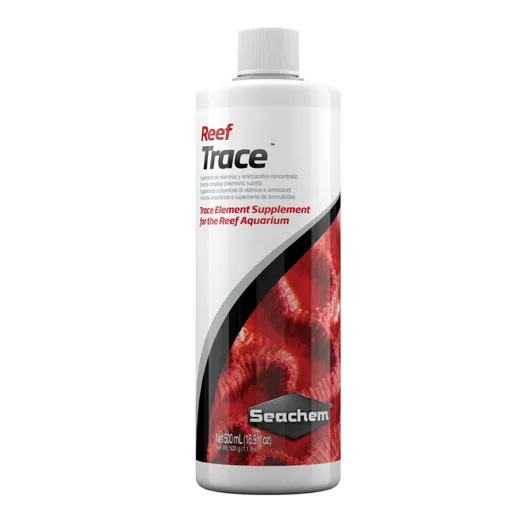
Seachem Reef Trace 500ml / 17oz
Reef Trace supplies a broad range of trace elements demonstrated to be necessary for proper reef health and growth. Trace elements are normally depleted by utilization, oxidation and precipitation. The latter two processes occur more rapidly than with other micronutrients. This makes it important to restore trace elements on a regular basis. Reef Trace may be used alone or in conjunction with Reef Plus. Best results are obtained when both are used. Reef Trace is nitrate/phosphate free.
| Guaranteed Analysis (Amounts per 1 g) |
|---|
| Boron (B): 0.028 mg |
| Cobalt (Co): 0.0003 mg |
| Copper (Cu): 0.032 mg |
| Manganese (Mn): 0.085 mg |
| Molybdenum (Mo): 0.003 mg |
| Zinc (Zn): 0.169 mg |
| Rubidium (Rb): 0.00008 mg |
| Nickel (Ni): 0.00003 mg |
| Vanadium (V): 0.00002 mg |
FAQ
Can Reef Trace be used with other supplements?
Yes, Reef Trace may be used alone or in conjunction with Reef Plus. Best results are obtained when both are used together.
Does Reef Trace contain nitrate or phosphate?
No, Reef Trace is nitrate and phosphate free.
How often should Reef Trace be added to the tank?
It is recommended to add Reef Trace regularly, typically every 4 to 6 weeks, depending on tank conditions and water testing results.


Amanda Quinn –
I’ve been using Reef Trace for about six months now and my coral growth has improved noticeably. The water parameters remain stable, and my reef tank looks healthier than before. I use it every four weeks with Reef Plus, and it’s become a staple in my maintenance routine.
Yvonne Blake –
The product arrived quickly and the instructions were clear. I added it to my tank once a month and noticed better coloration in my anemones. It’s a small amount, but it makes a difference in the overall health of the reef.
Boris Piper –
After switching from a previous trace element product, I saw a reduction in coral bleaching. Reef Trace has helped maintain consistent trace element levels, which I believe contributes to the stability of my reef system.