Red-Lined Wrasse – A Striking Addition to Your Reef Aquarium
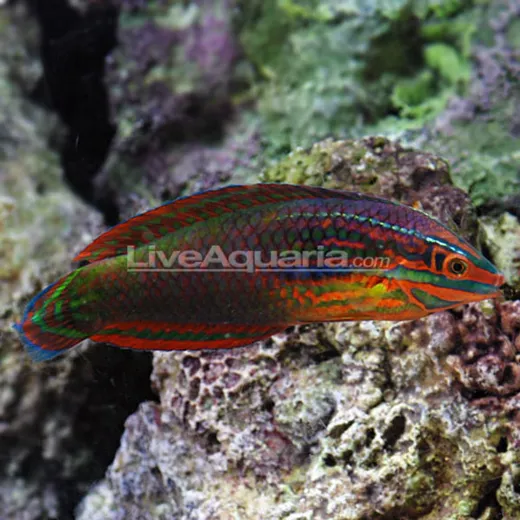
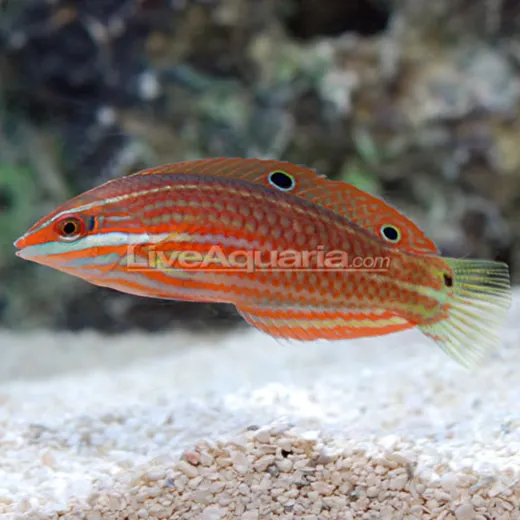
Bold, beautiful, and brimming with personality, the elegantly-striped Red-Lined Wrasse makes the perfect addition to showcase in your display reef aquarium. Also known in the hobby as the False-eyed or Biocellate Wrasse, juvenile Halichoeres biocellatus and sub adults are easily identifiable by a pair of ocelli, or “false eyes”, on the dorsal fin which disappear as the Red-Lined Wrasse matures.
The ideal setup for the Red-Lined Wrasse will be a well-established saltwater aquarium of at least 50 gallons in size with a tight-fitting lid. Aquascape liberally with live rock, making sure to include a large area of open substrate to best replicate the seaward reefs from which the Red-Lined Wrasse originates. In the wild, the Red-Lined Wrasse also prefers to inhabit reef crest areas.
| Species | Halichoeres biocellatus |
|---|---|
| Common Names | Red-Lined Wrasse, False-eyed Wrasse, Biocellate Wrasse |
| Adult Size | Up to 4 inches |
| Lifespan | 8–10 years |
| Water Temperature | 75–82°F |
| Water pH | 8.1–8.4 |
| Water Salinity | 1.020–1.025 |
FAQ
What are the distinguishing features of juvenile Red-Lined Wrasse?
Juvenile Red-Lined Wrasse have a pair of ocelli, or ‘false eyes’, on the dorsal fin, which are not present in adult fish.
What is the minimum tank size recommended for this species?
A well-established saltwater aquarium of at least 50 gallons is recommended.
Does the Red-Lined Wrasse require specific lighting or substrate?
It prefers a reef-like environment with live rock and open substrate to mimic its natural habitat. Regular lighting is not specifically required, but a stable, well-maintained setup is essential.


Carol Lyman –
The Red-Lined Wrasse has been a stunning centerpiece in my 75-gallon reef tank. The coloration is vibrant and the fish is very active. I noticed the false eyes in the juvenile stage, which was fascinating. It’s a great choice for a visually appealing species that doesn’t stress easily.
Evan Poole –
I’ve had this wrasse for six months now and it’s thriving. The tank setup includes live rock and open sand, which matches its natural habitat. The false eyes were visible when it was young, and it has since matured. It’s a beautiful fish that adds a lot of movement to the tank.
Nathan Turner –
This wrasse has become a highlight in my display tank. It’s active, curious, and doesn’t seem to compete with other fish. The color pattern is striking, and it’s easy to spot even from a distance. I appreciate the detailed care notes in the description.