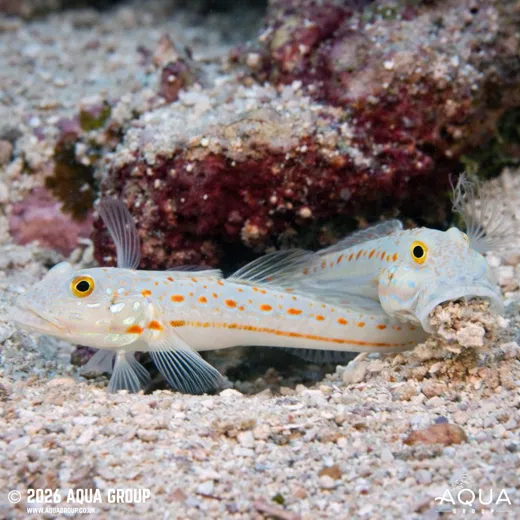
Orange Spot Goby
A pale sand-sifting goby marked with rows of bright orange spots. Industrious, peaceful and a genuine working part of a sand-bed system.
Feeding
Sifts sand for small invertebrates, and must also be fed directly – frozen mysis, enriched brine shrimp and sinking pellets, two or three times daily.
Compatibility
Peaceful and reef safe. Keep singly or as a bonded pair. Constant sand-sifting will dust low-lying corals.
Behaviour and personality
Takes mouthfuls of sand and sifts out the edible content, working methodically across the tank all day.
Before you buy
| Requirements | Details |
|---|---|
| Feeding | Deliberate feeding essential; will starve on sand fauna alone in most home tanks |
| Sand bed | Deep fine sand bed required |
| Tank setup | Sealed lid needed due to jumping behavior |
FAQ
What kind of food does the Orange Spot Goby require?
The Orange Spot Goby must be fed directly with frozen mysis, enriched brine shrimp, and sinking pellets, two or three times daily. It cannot survive on sand-dwelling invertebrates alone.
Is the Orange Spot Goby compatible with reef tanks?
Yes, it is peaceful and reef safe. However, its constant sand-sifting activity may dust low-lying corals, so placement should be considered.
How should I set up the tank for this goby?
Provide a deep fine sand bed and ensure the tank has a sealed lid, as the goby is known to jump.


Rebecca Piper –
The Orange Spot Goby is active and adds a lot of interest to the tank. I feed it mysis and sinking pellets daily, and it works through the sand diligently. It’s peaceful and doesn’t bother other fish. Only issue is it jumps, so I use a sealed lid. Great for sand-bed setups.
Thomas Avery –
I bought one for my reef tank and it’s been very calm. It sifts the sand regularly and seems to enjoy its work. I feed it twice a day with brine shrimp and pellets. It doesn’t damage corals, though I keep it away from low-lying ones.
Angela Howard –
This goby is a real workhorse. It’s active throughout the day, constantly sifting the sand. I make sure to feed it every morning and evening. It’s peaceful and fits well in a community tank with other reef-safe species.