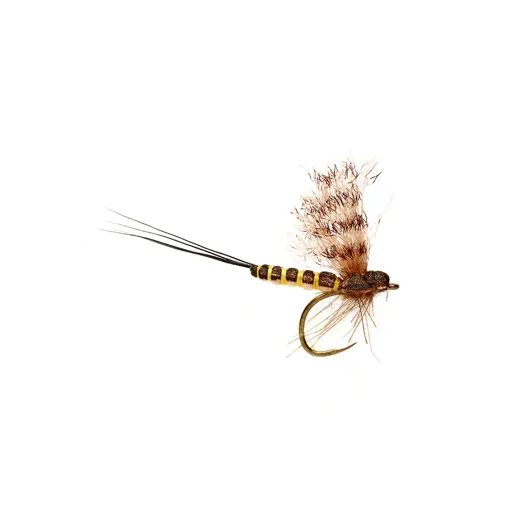
Mohican March Brown B/L
The true March Brown is a much localised ephemeropteran. Fortunately for us fly-fishers the difference is not that obvious between a few of these very large ‘Brown’ species, nor dare I say, is it to the trout! Of the various big brown jobs, the common and quite widespread Large Brook Dun is the fly most commonly confused with the genuine March Brown. So my pattern admirably covers both, also both species are of very similar sizes – within a millimetre or two! Again, as a pattern approaching Greendrake Mayfly size, it lends itself to the ‘Mohican’ extended body style, giving it a very predictable correct ‘sit’, and the soft poly wing collapsing like the natural on the trout’s ‘chomp’. I’ve used the pattern in this form for several years, and though our stretch of the Wharfe does not have a large population of March Browns, it has proven effective in mimicking the behaviour of both species.
Specifications
| Feature | Detail |
|---|---|
| Pattern Type | March Brown / Large Brook Dun |
| Body Style | Mohican extended |
| Wing Material | Soft poly |
| Size Reference | Approaching Greendrake Mayfly size |
FAQ
What species does the Mohican March Brown B/L imitate?
The pattern imitates both the March Brown and the Large Brook Dun, which are similar in size and behaviour, often confused in the field.
Is the soft poly wing realistic in action?
Yes, the soft poly wing collapses naturally when presented to the trout, mimicking the way the real insect behaves during a ‘chomp’.
Is this pattern suitable for use in cold or fast-moving waters?
Please contact customer service


Anna Graham –
This fly works well in our local streams. I’ve used it during spring runs and it catches trout consistently. The body sits naturally and the wing collapses just right when the fish takes it.
Warren Abraham –
A solid imitation of the March Brown. It’s a bit larger than expected, but that’s fine since it matches the size of the real insects. I caught a few fish on it during a dry spell.
Charles Arnold –
Great detail and realistic movement. I’ve used it for several seasons now and it’s one of my go-to patterns when fishing in early spring.