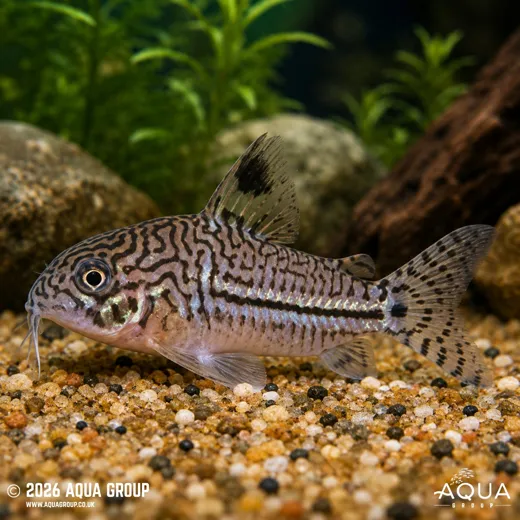
Leopard Cory
A finely spotted cory with a dark lateral line running the body, sometimes sold as the three-line cory. Hardy, peaceful and a long-standing community favourite.
Feeding
Sinking pellets, wafers and frozen foods, delivered in enough quantity to reach the bottom.
Compatibility
Entirely peaceful. Keep in groups of six or more.
Behaviour and personality
Busy bottom-dweller, active during the day and constantly sifting the substrate.
Before you buy
Soft sand protects the barbels. Frequently confused with the very similar Hoplisoma julii, and the two are often mixed in the trade.
| Specification | Value |
|---|---|
| Species | Leopard Cory (Corydoras aeneus) |
| Size | 2.5 inches |
| Temperature | 72–78°F |
| Water pH | 6.0–7.5 |
| Hardness | 2–8 dGH |
| Group Size | 6 or more |
FAQ
What kind of substrate is best for Leopard Cory?
Soft sand is recommended to protect their sensitive barbels.
Can Leopard Cory be kept with other fish?
Yes, they are entirely peaceful and can be kept with other community fish when housed in groups of six or more.
How often should I feed my Leopard Cory?
Feed once or twice daily with sinking pellets, wafers, or frozen foods that reach the bottom of the tank.


Paul Scott –
My Leopard Cory has been in the tank for three months and is very active. It enjoys the sinking food and spends most of the day sifting through the sand. The fish is calm and doesn’t bother other tank mates. I’m happy with the purchase.
Melanie Bower –
I bought this cory for my community tank. It’s peaceful and fits well with my other fish. I noticed it’s more active in the morning and spends time near the bottom. The only thing is it does need soft sand to avoid barbel damage.
Tim Kerr –
Great addition to my aquarium. The fish is hardy and easy to care for. I keep six of them together and they seem to get along well. They’re always active and clean the substrate regularly.