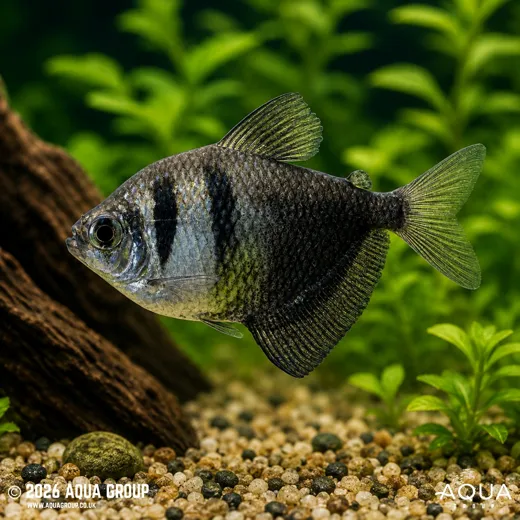
Black Widow Tetra
A deep-bodied tetra, dark grey-black at the rear with a large flowing anal fin. The black fades to silver-grey with age, which is normal rather than a sign of ill health.
Feeding
Flake, pellets and frozen foods. Enthusiastic and easy to feed.
Compatibility
Can nip fins, particularly in small groups. Keep in groups of eight or more and avoid slow, long-finned tankmates such as guppies, bettas and angelfish.
Behaviour and personality
Active and assertive. Occupies the middle of the tank and feeds vigorously.
Before you buy
| Important note | The dramatic black of a young fish fades substantially as it matures. If you want the dark colour permanently, this is not the fish. Nipping is much reduced in larger groups. |
|---|
FAQ
What is the color change in Black Widow Tetras as they age?
The dark grey-black coloration of young Black Widow Tetras fades to silver-grey as they mature. This is normal and not a sign of health issues.
How many fish should I keep to minimize nipping behavior?
Keep at least eight fish together to reduce nipping behavior. Larger groups help minimize aggression toward other fish.
Are Black Widow Tetras suitable for tanks with long-finned fish?
No, they can nip at long fins. Avoid keeping them with slow, long-finned species like guppies, bettas, or angelfish.


Benjamin Gray –
The Black Widow Tetras are active and lively in the tank. They start dark but become silver-grey over time. I kept them in a group of eight, which helped reduce fin-nipping. Easy to feed with flakes and frozen foods.
Warren Berry –
They are bold and occupy the middle of the tank. The color change is noticeable after a few months. I didn’t expect the silvering, but it’s natural. Good for a dynamic community tank.
Brandon Slater –
Great for active aquariums. The fish are hardy and eat well. I noticed less aggression when I increased the group size to ten. They don’t harm other fish when kept properly.