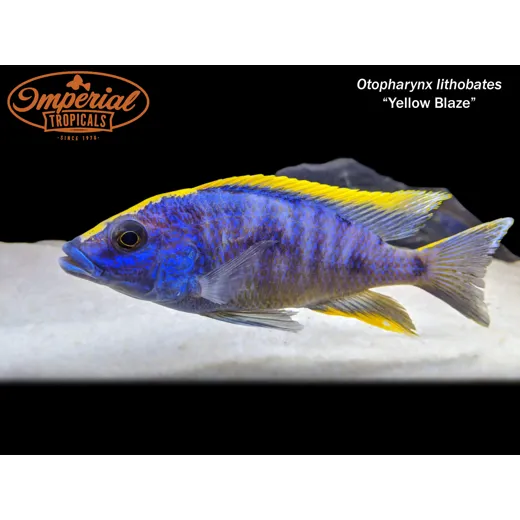
Yellow Blaze
Scientific Name: Otopharynx lithobates
Common Name: Yellow Blaze
Max Size: 6″
pH: 7.5-8.4
Hardness: Hard
Temperature: 74-82°
Aggressiveness: Aggressive
Region of Origin: Malawi
Yellow Blaze (Otopharynx lithobates) are a striking Malawi Hap known for their long, pointed bodies and three distinct black spots on the flanks. Males develop a deep blue coloration and display a signature ‘blaze’ running from the nose to the back of the dorsal fin when they reach about 3″ in length. Females are mostly gray with occasional blue tints and are typically found foraging in rocky areas. These fish naturally inhabit caves and rocky crevices, making them well-suited for tanks with complex structures and hiding spots.
| Feature | Detail |
|---|---|
| Max Size | 6″ |
| pH Range | 7.5–8.4 |
| Water Hardness | Hard |
| Temperature Range | 74–82°F |
| Aggressiveness | Aggressive |
| Origin | Malawi |
FAQ
What is the typical size of a Yellow Blaze fish?
The maximum size of a Yellow Blaze is 6 inches.
When do male Yellow Blaze fish develop their blue blaze?
Male Yellow Blaze begin to show their deep blue ‘blaze’ from the nose to the dorsal fin when they reach about 3 inches in length.
What kind of water conditions do Yellow Blaze prefer?
They thrive in water with a pH between 7.5 and 8.4, hard water, and a temperature range of 74–82°F.


Piers Greene –
The Yellow Blaze are quite active and colorful. I noticed the males developed their blue blaze after a few weeks. They do require a well-structured tank with caves and rocks. Aggressive behavior is noticeable, so I made sure to keep them with compatible species.
Keith Hemmings –
These fish are beautiful and show off their markings well. I kept one male and one female, and the male’s blue blaze appeared after reaching 3 inches. The water parameters need to be stable, and I’ve maintained pH and hardness carefully.
Edward Turner –
The fish are visually appealing, but they are aggressive and need space. I had to adjust the tank layout to give them enough room. They do not do well in small or open tanks.